Latest News

Major development projects are being proposed and approved that will have major impact on our community.

WAILEA808 IDENTIFIED ISSUES IN REDEVELOPMENT OF WAILEA GOLF LLC
Our Concerns:
Wailea Golf LLC redevelopment, with significant modification / elimination of two golf courses and planned residential and commercial construction will result in:
-
Loss of open space.
-
Loss of fire breaks.
-
Increased traffic.
-
Impeded disaster evacuation from Wailea, Makena and points south.
-
Economic impact on local economy.
-
Reduced availability of recreational facilities.
-
Increase in noise and light pollution.
-
Loss of access to two 18-hole golf courses for residents and visitors.
-
Decreased property values.
-
Impact on response times from First Responders - need additional staffing for police, firefighters, and EMT's as well as possibly new satellite stations for the safety of Maui County residents.
CURRENT SMCP MAP AND ZONING OF WAILEA GOLF LLC

PROPOSED CHANGES TO NEW SMCP FOR WAILEA GOLF LLC

WAILEA808 ACTION PLAN TO ADDRESS
THE WAILEA GOLF LLC REDEVELOPMENT
-
Continue working with the Commission on Water Resource Management
-
Continue working with each County Council Member
-
Monitor and attend key County Council meetings.
-
Work with WCA and monitor & attend key WCA meetings.
-
Collaborate with Maui Tomorrow, Sierra Club, Kihei Community Association and others.
-
Hire experts and legal team to assist with our actions

WELCOME TO
Wailea808
WAILEA808 IDENTIFIED ISSUES IN MAJOR PLANNED GROWTH IN SOUTH MAUI
-
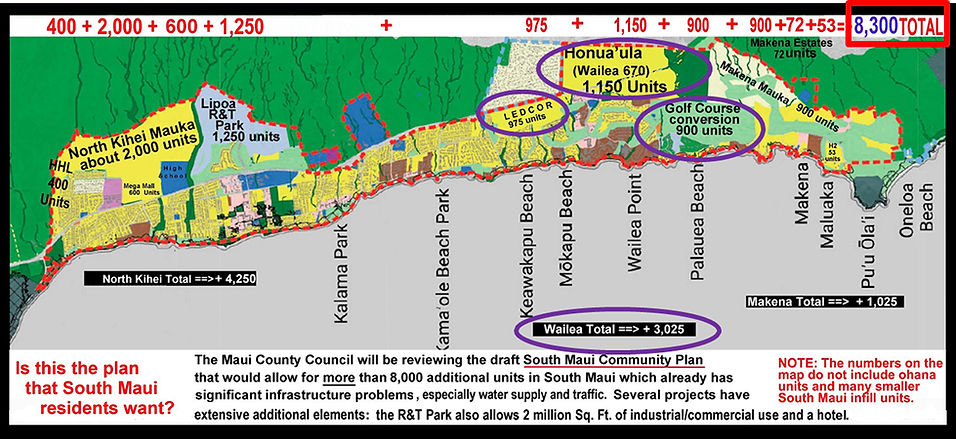
The 2025 South Maui Community Plan (SMCP) has approximately 8,300 homes in South Maui for future development. The last level for approval is the County Council, scheduled approximately mid year.
-
Infrastructure Issues
-
Traffic - widening the Piilani - who, when, how much?
-
Emergency egress is woefully inadequate for fire, hurricane, tsunami, etc.. Makena would be blocked in worse than any other community because of their location as the furthest point out.
-
-
Water
-
The Kamaole aquifer has reached 90% Sustainable Yield (SY) of its 11 MGD requirement by the State.
-
Future Developments will not have access to the Kamaole aquifer at least in the next three years.
-
If the Developers propose to use alternative water technologies such as Reverse Osmosis (RO), this technology uses a tremendous amount of energy and requires approximately two gallons of source water to make one gallon of potable water.. So, if a unit (home) needs 500 Gallons Per Day (GPD) of potable water, then the water source needs to provide 1,000 GPD. With the addition of 1,000 (homes) units, this translates to 1 Million GPD from the water source. Discharge of wastewater from the RO process creates another unaddressed challenge; huge ecological impacts due to the saline byproducts.
-
-
-
First Responders
-
Fire, Police and EMT resources must be increased to support this growth. Additional satellite stations must be planned and built to respond in a timely manner for the safety of Maui County residents.
-
Join us in our mission to create a thriving and balanced community. Your support and engagement make a real difference.
Together, we can shape a better future for our county.


Blue Course Emerald Course

Gold Course
We Need You to
Support Our Shared Cause

FOR IMMEDIATE RELEASE
Date: February 17, 2026
Media Contacts:
-
Kīhei Community Association (KCA): John Laney, President; 808-633-1030; johnnielaney@gmail.com.
-
Maui Meadows Neighborhood Association (MMNA): Les Iczkovitz, President; 808-523-8449; les.iczkovitz@gmail.com.
-
Wailea808: Kay Anderson, President; 469-733-5972; kayandesron1@att.net.
KCA, MMNA, and Wailea808 Petition the State to Designate the Kama‘ole Aquifer as a Ground Water Management Area
KĪHEI, MAUI — The Kīhei Community Association, the Maui Meadows Neighborhood Association, and Wailea808 have submitted a petition asking the State’s Commission on Water Resource Management (CWRM) to designate the Kama‘ole Aquifer Area as a Ground Water Management Area (GWMA) just like it has already done for the Central Maui’s Na Wai Eha and W. Maui aquifers.
This designation would provide stronger, transparent oversight of groundwater withdrawals to protect South Maui’s water future in the face of growing demand, and climate-driven reductions in recharge and rising ocean levels.
Current and planned withdrawals in Kama‘ole exceed 90% of the aquifer’s estimated sustainable yield (11 million gallons per day), meeting a key statutory criterion for GWMA designation.
Climate science forecasts significantly reduced recharge ahead; for Kama‘ole, the U.S. Geological Survey forecasts approximately a 23% (about 16 mgd) decrease in annual mean rainfall recharge under a mid-century dry climate scenario.
Groundwater levels documented in monitoring data also show a significant trend of water level decrease, including a decrease of 0.07 feet per year over the past 23 years at the Waiohuli observation well.
What Petitioners are requesting
Petitioners are asking the Commission to designate Kama`ole aquifer as a GWMA, which means developers of existing and new water sources must obtain a permit that requires them to disclose their uses, whether they’ve considered alternatives, and to show their uses are not harming the ecosystem, Hawaiian customary rights, domestic water uses, or DHHL’s water uses. The Commission has already taken these steps for the West Maui GWMA. It has also designated every one of Oahu’s aquifers, as well as the entire island of Molokai.
Why a Ground Water Management Area matters
When an aquifer remains undesignated, the Commission lacks power to comprehensively manage groundwater uses. Petitioners argue that a GWMA designation is a common-sense planning step to ensure South Maui’s groundwater is managed sustainably, with transparency and enforceable protections, before over-withdrawal becomes irreversible.
Quotes
“Every credible signal is pointing in the same direction: less recharge in the future and rising demand today. It would be reckless to keep adding withdrawals without stronger oversight. A Ground Water Management Area is a practical step to protect this aquifer and the community that depends on it.” John Laney, President, Kīhei Community Association
“This is basic risk management. Climate models point to reduced recharge, and South Maui’s demand pressures aren’t slowing down. If we don’t designate Kama‘ole now, we’re locking in future scarcity, exactly when we should be prioritizing water for resident housing and essential uses.” Les Iczkovitz, President, Maui Meadows Neighborhood Association
“It is reckless for the County and large landowners to plan on adding thousands more homes in S Maui when we don’t know how much more water the aquifer holds. We have maps and diagrams of this massive amount of proposed developments that make it easy to see why the current system is like an uncontrolled land rush, where it is better to be early than late, to start pumping groundwater. We need the State to use its supervisory authority to assess and regulate the aquifer.” Kay Anderson, President, Wailea808
What’s next
Petitioners urge community members, water users, and decision-makers to participate in the public process and provide testimony supporting the designation of the Kama‘ole Aquifer as a Ground Water Management Area.
Attachments / visuals available:
-
Petition and Exhibits (including recharge projections + monitoring well trends)
-
Table of Approved and Proposed Developments
-
List of Additional South Maui (Kamaole Aquifer) Projects
-
Diagram of Proposed South Maui Projects
-
Map of Kama‘ole Aquifer boundaries
About the Petitioners
KCA, MMNA, and Wailea808 are South Maui nonprofit community organizations focused on education, advocacy, and the well-being of our community and residents, including those living directly atop the Kama‘ole Aquifer System Area.
— END —

Get in Touch
Phone: (469) 733 5972
Email: 808wailea@gmail.com
Website: www.808wailea.com
Mailing Address: 90 Kai La Place
Wailea, HI 96753
